
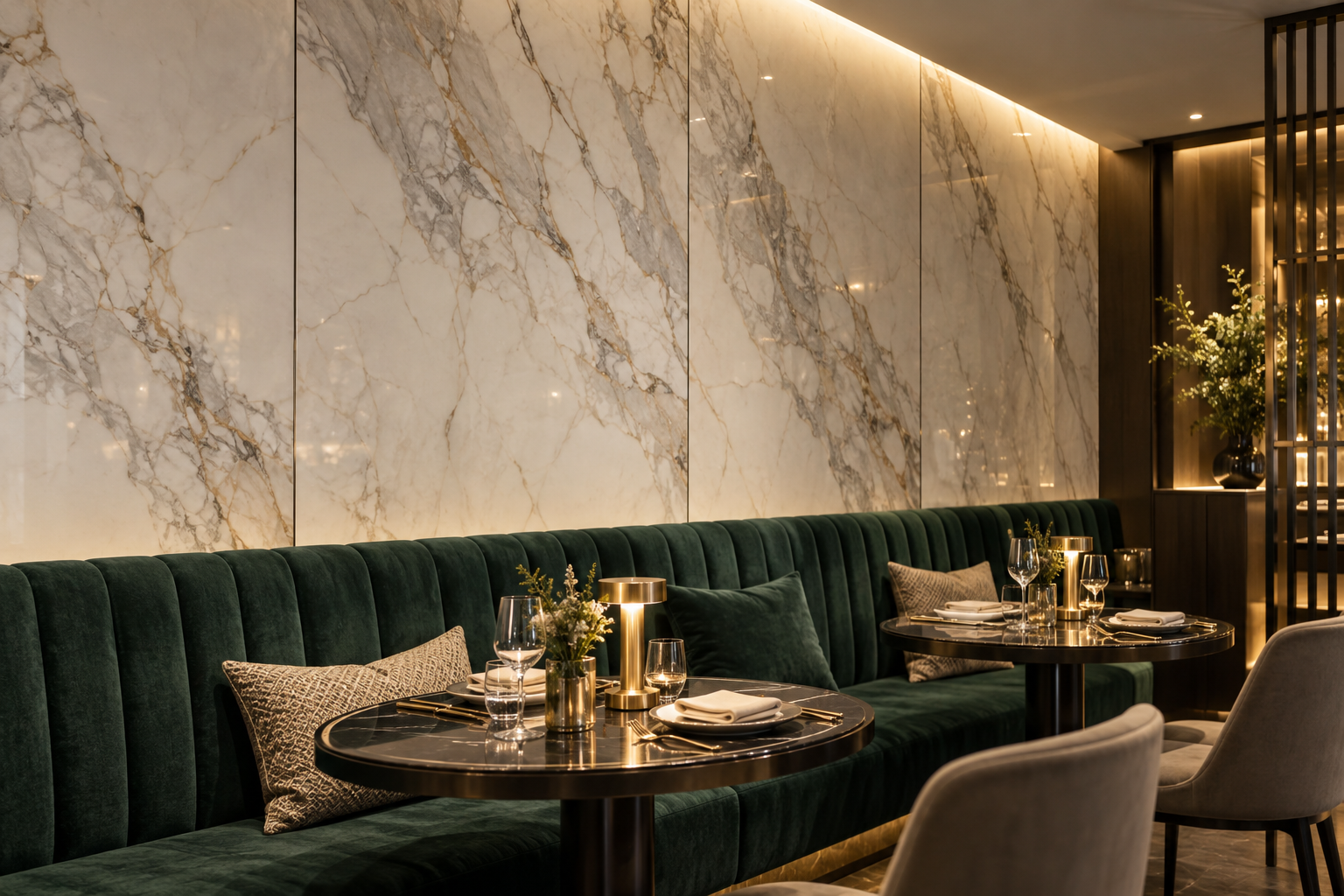
UV marble sheets: separating heat limits from fire ratings
A B1 fire rating says nothing about where a wall can be installed. How to keep heat exposure, fire evidence and fixing detail as separate decisions when specifying UV marble sheets.
- 500 m²MOQ per colour
- 15-25 daysProduction lead time
- 3 daysSample dispatch
- 16 linesWall, ceiling & floor
- 100+Export countries
- ISO 9001Quality system
- E0 / B1Formaldehyde & fire
- QingdaoLoading port
UV marble sheets · 2026-10-10
Two different questions, routinely confused
Fire rating answers what happens when the material is exposed to a fire. It does not answer where the material can be installed. A B1 rated UV marble sheet can still be the wrong product behind a continuous heat source, and buyers frequently treat the fire certificate as evidence that any location is acceptable.
Keep the two calculations separate. Fire evidence is a compliance question answered by a test report. Heat exposure is a durability question answered by the service temperature of the panel and the adhesive.
Where heat actually causes failures
The failures we see are dulling and edge lifting rather than anything dramatic. A decorative sheet installed too close to a continuous heat source loses gloss, and the adhesive behind it softens, letting the panel edge lift. The defect appears months after handover, when the certificate has already been filed.
- Keep a 300 mm clearance from continuous heat sources such as hobs, grills and radiators
- Avoid direct mounting behind equipment that radiates heat into the wall face
- Use a heat-resistant adhesive where temporary high temperatures are expected
- Never seal a panel rigidly at both edges; leave a movement joint for thermal expansion
What the fire evidence should contain
Ask for the test report rather than a summary line on a specification sheet. The report should identify the product, the thickness, the substrate and the mounting method tested, because the classification applies to that build-up rather than to the material in isolation.
| Report item | What it must state |
|---|---|
| Product identity | Exact product and thickness tested |
| Substrate | Substrate and mounting used in the test |
| Classification | Achieved class and the standard applied |
| Test date | Within the validity your authority requires |
| Scope | Whether the result transfers to other thicknesses |
Joint and fixing detail carries the risk
In a wet or hot zone the joint is the weak point. Specify a neutral-cure sealant rather than an acetic one, and avoid rigid sealing at both ends of a long run. Where panels sit above a cooking line, a mechanically fixed trim is more reliable than adhesive alone.
Pre-order checklist
- Confirm the service temperature of the panel with the manufacturer, not from a brochure
- Keep 300 mm minimum from continuous heat sources
- Obtain the full test report and check it matches your thickness and mounting
- Specify a neutral-cure sealant in wet and hot zones
- Leave a movement joint at long runs and do not rigidly seal both edges
- Record the fixing system in the handover pack for future maintenance
Ask us to check your specification
Send the drawing, the exposure condition and the quantity. We will confirm the panel, the substrate and the fixing before you commit to a container.
Request a quotation on WhatsAppor email info@chanta.group