
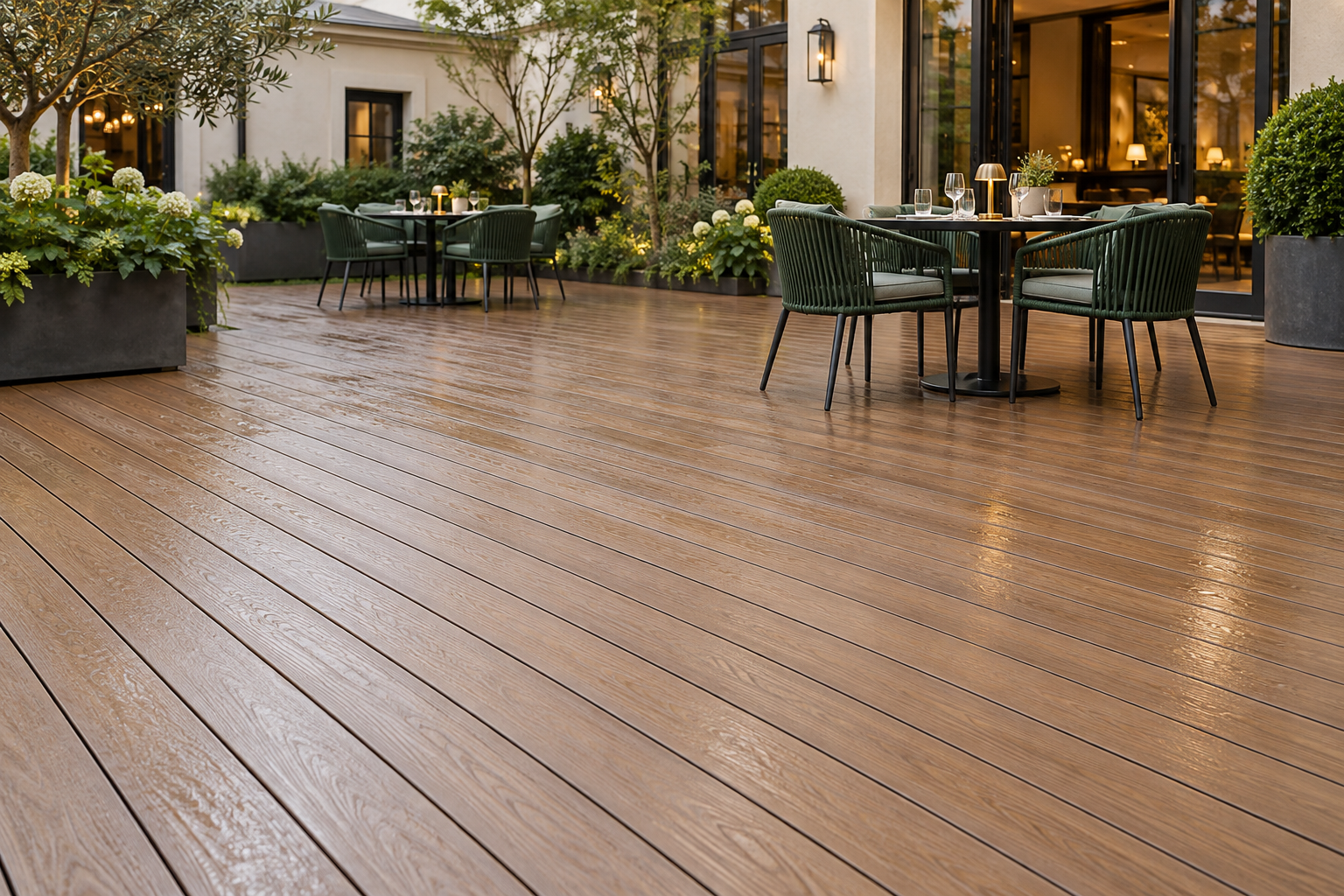
WPC decking: assessing wet slip resistance for restaurant terraces
A slip rating only holds while the surface is clean. How to assess composite decking for a wet restaurant terrace, check the test conditions, and plan the cleaning regime into the specification.
- 500 m²MOQ per colour
- 15-25 daysProduction lead time
- 3 daysSample dispatch
- 16 linesWall, ceiling & floor
- 100+Export countries
- ISO 9001Quality system
- E0 / B1Formaldehyde & fire
- QingdaoLoading port
WPC decking · 2026-10-10
Slip resistance is a wet question
Dry slip resistance is easy to achieve and almost meaningless for a terrace. The relevant measurement is taken on a wet surface, and it is specific to the surface profile of the board rather than to the product family. Two boards from the same catalogue with different embossing can return noticeably different wet results.
Ask for the wet test result for the exact surface you are specifying, and record it against the project. A generic claim that the product is slip resistant does not survive a claim after a fall.
The cleaning regime is part of the rating
Any slip rating assumes a clean surface. A film of algae, cooking grease or leaf mulch on a terrace deck defeats the measurement entirely. This matters most exactly where the specification is most safety-critical: restaurant terraces, pool surrounds and hotel walkways.
For a restaurant, the exposure is food grease and spillage as well as rain. Agree a cleaning interval and a method with the operator, then choose a surface profile that can actually be cleaned on that schedule. A deep open grain that traps grease is the wrong choice regardless of its test figure.
- Establish the cleaning frequency and method before choosing the surface
- Avoid deep open grooves where grease or leaf litter will collect
- Plan drainage so water does not stand on the deck after rain
- Clean with a stiff brush and a mild detergent; avoid aggressive solvents on composite
Ventilation under the deck decides the long term
A deck with no airflow beneath it stays damp, and a damp deck grows the film that causes slipping. Maintain at least 25 mm of ventilation under the boards, set joists at 300–350 mm centres, and never lay boards directly onto soil or a solid slab.
| Parameter | Specification for a commercial terrace |
|---|---|
| Joist spacing | 300 mm centres |
| Ventilation under boards | 25 mm minimum, cross-flowing |
| Board to board gap | 4–6 mm |
| Board type | Solid board where furniture and trolleys are moved |
| Fixings | Stainless steel concealed clips |
| Cleaning | Brush and mild detergent on an agreed schedule |
Assessing a supplier before you order
Comparable-looking boards differ in core density, clip design and how the embossed surface is produced. The differences show up in the wet slip result, in how the board holds a screw, and in whether the colour survives two summers. Ask for the specific evidence rather than a sample box.
Pre-order checklist
- Request the wet slip test result for the exact surface profile
- Confirm the embossing is one that can be cleaned on your schedule
- Check the recommended joist spacing for commercial traffic, not residential
- Verify the ventilation depth and drainage falls on the terrace drawing
- Specify stainless steel concealed clips for a wet environment
- Agree a cleaning interval with the operator and record it in the handover pack
Ask us to check your specification
Send the drawing, the exposure condition and the quantity. We will confirm the panel, the substrate and the fixing before you commit to a container.
Request a quotation on WhatsAppor email info@chanta.group