
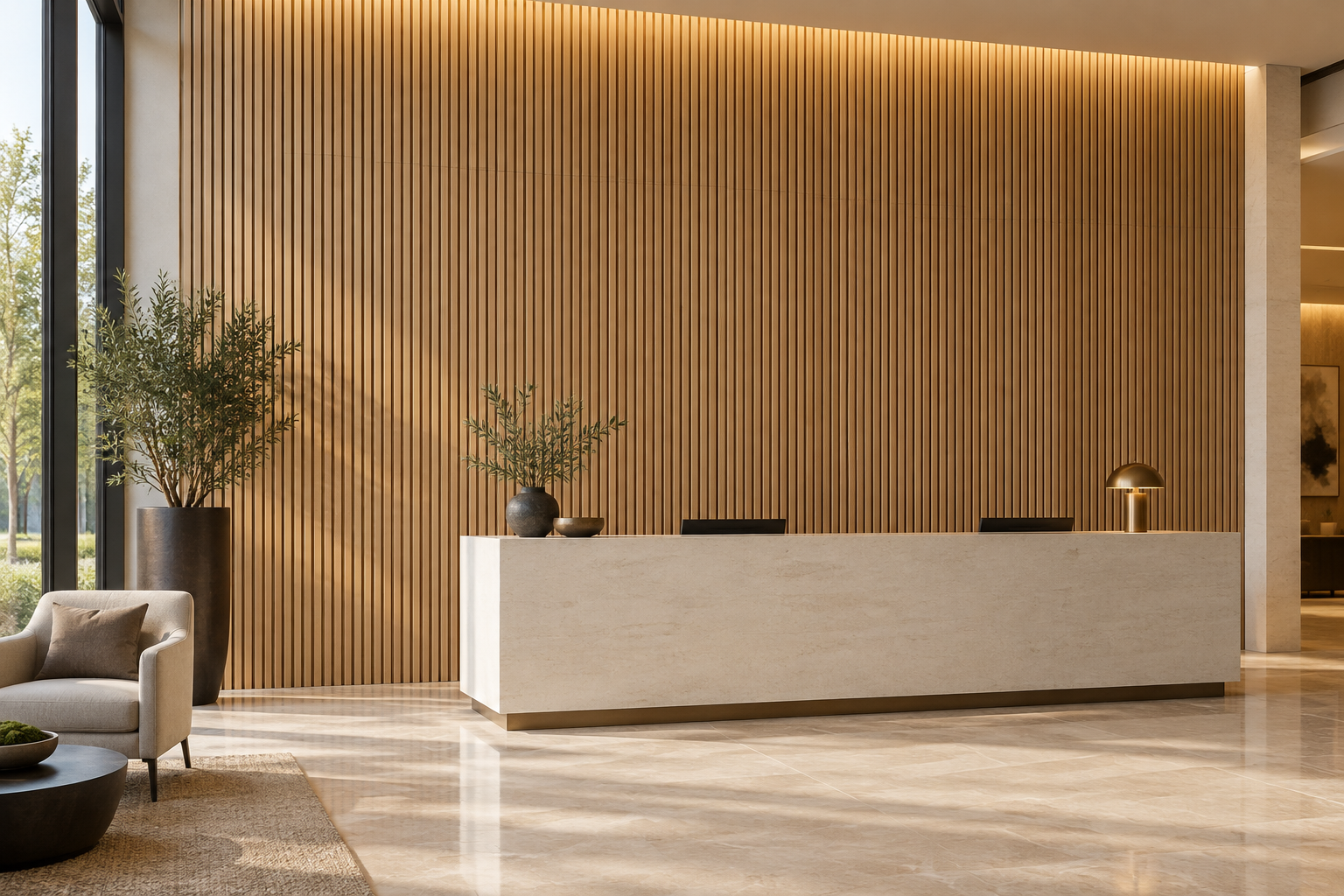
WPC wall panels: specifying flute alignment under grazing light
Fluted WPC wall panels are judged under raking light, where a 1 mm set-out error reads as 10 mm. How to specify alignment, set out from the centre, and check the substrate before bulk ordering.
- 500 m²MOQ per colour
- 15-25 daysProduction lead time
- 3 daysSample dispatch
- 16 linesWall, ceiling & floor
- 100+Export countries
- ISO 9001Quality system
- E0 / B1Formaldehyde & fire
- QingdaoLoading port
WPC wall panels · 2026-10-10
Why grazing light exposes alignment
A fluted or slatted wall panel is a repeating shadow pattern. When light crosses it at a shallow angle, each flute edge casts a shadow of its own, so the eye can compare adjacent shadows directly. A variation that is invisible under diffuse ceiling light becomes obvious under a wall washer.
This is why a wall that looked correct in the sample room can be rejected at handover. The panel did not change; the lighting did. Fix the lighting condition as part of the specification, not as something the electrician decides at the end.
Set out from the centre, not the corner
A wall is read from the centre. If the set-out line starts at a corner, any accumulating error collects at the far end, where the final cut panel becomes visibly narrow. If the set-out starts at the centre and works outward, the two end panels are equal and the variation is halved.
For a wall with a focal point — a reception desk, a TV, a doorway — set out on that axis so the pattern is symmetrical about what the eye is drawn to.
- Mark the centre line of the wall or of the focal object first
- Divide the available width by the panel pitch and round to the nearest whole number
- Adjust the two end panels to equal widths, keeping both above a third of a panel
- Check the first three panels for plumb before continuing; every later panel follows the first
Substrate tolerance is the hidden variable
A fluted panel follows the substrate. On a wall that is bowed by 8 mm over 3 metres, the flute line will curve with it and the shadows will vary along the run — which reads as a manufacturing defect even though the panel is straight.
Check the substrate with a 2 m straight edge and record the deviation, then resolve it with battens rather than expecting the panel to bridge it. A clip or batten system with a shimmed batten line is almost always cheaper than returning panels.
| Common substrate | Plasterboard on stud |
|---|---|
| Acceptable deviation | 3 mm over 2 m |
| Typical measured | 4–8 mm on older walls |
| Fix | Shimmed battens at 400 mm centres |
| Effect on flutes | Straight line maintained across the run |
What to check before placing a bulk order
Most alignment failures are decided before the container is loaded. A short inspection routine at sample stage removes the risk, and it costs one afternoon rather than a rejected container.
Pre-order checklist
- Fit three panels from one carton on a 2 m straight edge and inspect under the project lighting
- Measure the flute pitch across three panels and confirm it is consistent
- Check the panel edge straightness; a bowed edge will not close tight over a long run
- Confirm the lighting condition with the consultant before approving panels
- Record the substrate deviation and resolve it before cladding starts
- Keep the approved sample panel on site as the reference for the whole installation
Ask us to check your specification
Send the drawing, the exposure condition and the quantity. We will confirm the panel, the substrate and the fixing before you commit to a container.
Request a quotation on WhatsAppor email info@chanta.group